
Snake Bite
Snake bite is one of humanity’s oldest and biggest killers, claiming over 100,000 lives each year worldwide and leaving another 400,000 with disabilities, mostly in the poorest communities. After mosquitoes, which transmit diseases like malaria and dengue, and humans themselves, snakes are among the deadliest creatures on Earth. Fortunately, not every snakebite results in envenomation. Fewer than 20% of snake species in the world are considered medically important, and even venomous snakes don’t always inject venom (dry bite).1 However, when venom is injected, its effects can be rapid, severe, and potentially life-threatening.
In India, where roughly half of the world’s snakebite deaths happen, underreporting remains rampant. Many victims die in villages, in the fields, or on their way to hospitals.
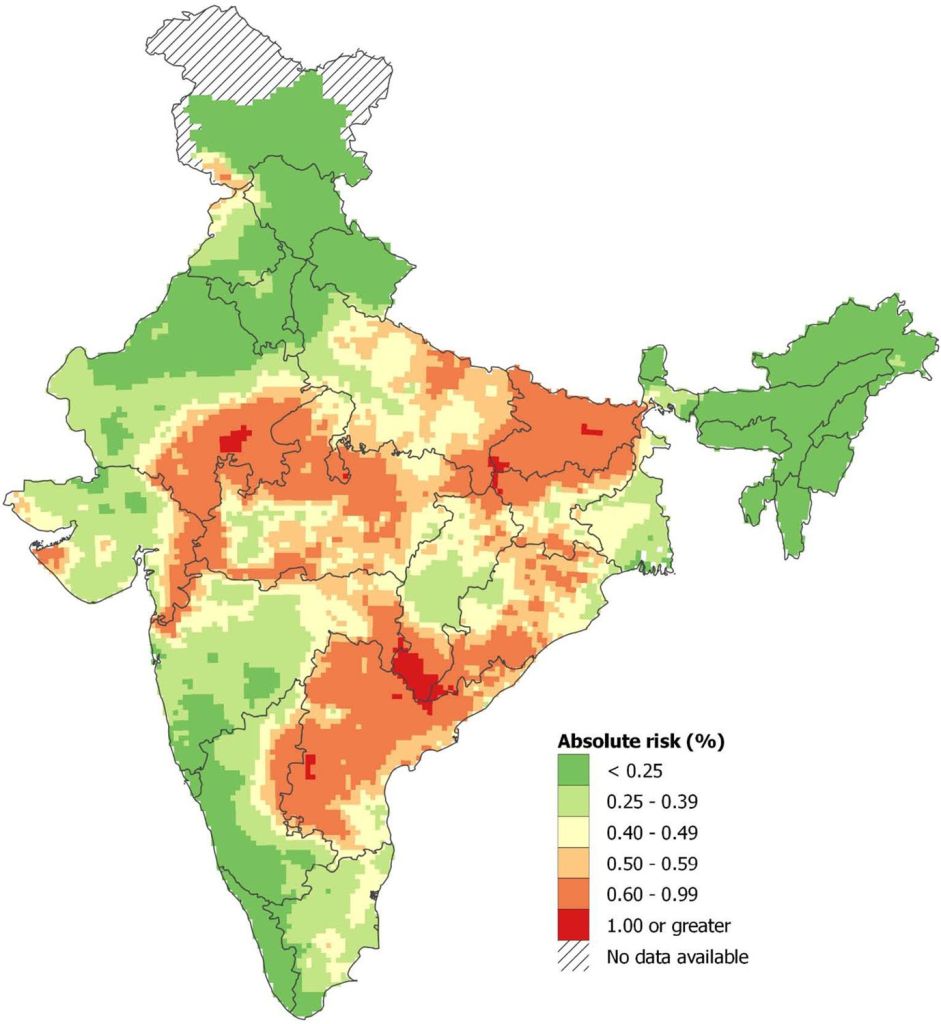
Spatial distribution of snakebite mortality risk, India, 2004-2013. 2
Although expensive biotechnological approaches, such as serologic identification of snakebite species and the development of safer, more highly purified antivenoms, have the potential to reduce future mortality rates, many immediate community needs remain unmet.3
Our goal is to use low-cost measures to prevent bites rather than relying on advanced interventions after a bite occurs. We continue our clinic-based prevention work in the Velangi area with 2 key principles, built around the communities where snakebites happen:
1. Community Education, and 2. First Response.
COMMUNITY EDUCATION- PREVENTION
Around the House
- Keep grass and weeds trimmed
- Remove piles of debris, firewood, bricks, rocks, and construction materials where snakes can hide.
- Store firewood and building materials off the ground on racks or platforms.
- Seal gaps and holes in foundations, walls, doors, and roofs that could allow snakes to enter.
- Install door sweeps and repair damaged screens.
Control Rodents
Many medically important snakes in South India, such as cobras and kraits, are attracted by the presence of rodents.
- Store grain, rice, and animal feed in sealed containers.
- Clean up food scraps and dispose of garbage properly.
- Reduce rat and mouse populations around the property. (Cheap bucket mouse trap instructions and materials provided to local farmers)
Outdoor Lighting
- Use flashlights or headlamps at night, especially during the monsoon season.
- Install adequate outdoor lighting around pathways, toilets, and water sources.
- Never walk barefoot outdoors after dark.
Personal Protection
- Wear closed-toe shoes or boots when working outdoors.
- Use a stick to probe vegetation or leaf litter before reaching into it.
- Be aware and alert when moving firewood, debris, or rocks.
- Avoid putting hands into holes, crevices, or dense vegetation without checking first.
Sleeping Precautions
- Sleep on a raised cot rather than directly on the floor.
- Use a well-tucked mosquito net, which can also help prevent snakes from reaching sleepers.
- Keep bedding and clothing off the floor.
- Shake out shoes, blankets, and clothes before use.
Yard and Farm Management
- Clear vegetation around pathways.
- Maintain a buffer zone of short grass around homes.
- Avoid walking through fields at night without a light.
- Keep livestock areas clean and free of rodent infestations.
If You See a Snake
- Do not attempt to catch, kill, or handle it.
- Keep children and pets away.
- Contact a local snake rescuer or wildlife authority if available.
- Remember that many bites occur when people try to kill snakes.
Studies suggest that many snakebites can be prevented through these relatively low-cost measures, often more effectively than relying solely on advanced medical interventions after a bite occurs.
FIRST RESPONSE
Presume all suspected snakebites as if they could be deadly: don’t panic, stop what you are doing, and initiate first aid. Snake venom enters the bloodstream via the low-pressure lymphatic system. This network of channels drains fluid from our limbs outside the blood vessels, where venom is usually injected. As our muscles help pump this system, the worst thing you can do is to panic and run for help, as this will accelerate the circulation and action of the injected toxins.
Immobilize the person’s limb with a splint and keep it still while the transport arrives.
- Pucca MB, Knudsen C, S. Oliveira I, Rimbault C, A. Cerni F, Wen FH, Sachett J, Sartim MA, Laustsen AH, Monteiro WM. Current Knowledge on Snake Dry Bites. Toxins. 2020; 12(11):668. https://doi.org/10.3390/toxins12110668
- Wilson Suraweera, David Warrell, Romulus Whitaker, Geetha Menon, Rashmi Rodrigues, Sze Hang Fu, Rehana Begum, Prabha Sati, Kapila Piyasena, Mehak Bhatia, Patrick Brown, Prabhat Jha (2020) Trends in snakebite deaths in India from 2000 to 2019 in a nationally representative mortality study eLife 9:e54076
- https://www.thinkglobalhealth.org/article/antivenom-plan-india
 The Praana Foundation Inc.